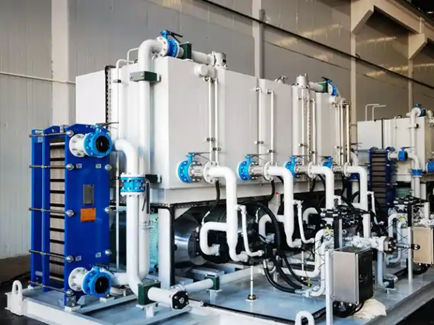
In hydraulic systems, butterfly valves are predominantly utilized in the suction lines of hydraulic pumps. Their primary function is to isolate the suction path, preventing hydraulic oil from leaking out of the reservoir during pump replacement or maintenance. While butterfly valves also find applications in water-cooling circuits, this article focuses specifically on their critical role in hydraulic power units.
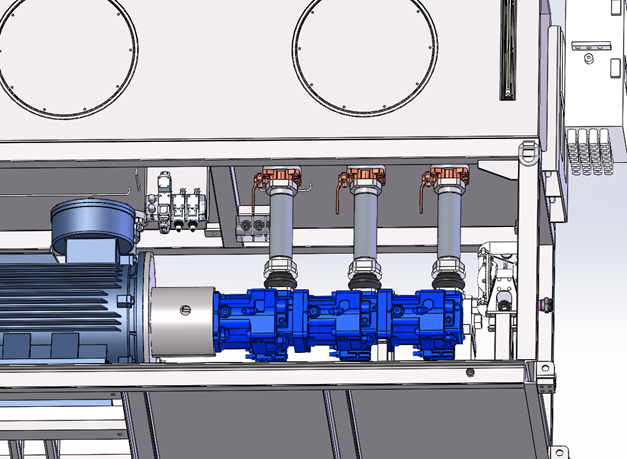
Fig 1. 3D visualization showing the compact SAE butterfly valve integration on a TBM suction line.
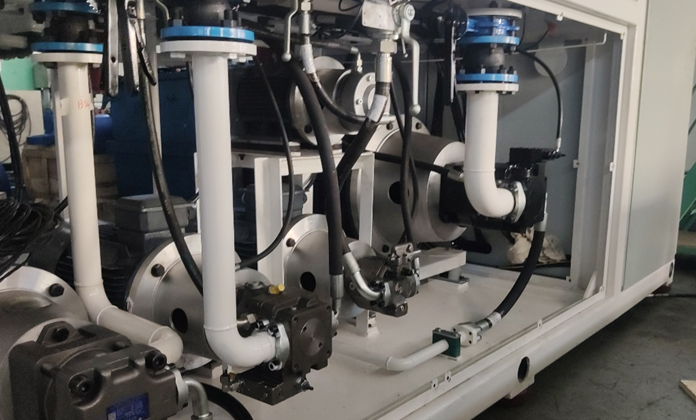
Fig 2. Wafer-type butterfly valve application on the suction line of a hydraulic cylinder test bench.
Are you wondering if a butterfly valve is the right fit for your project? This guide provides an expert overview to assist in your decision-making and provide a technical reference for procurement or system design.
1. Selection of Rubber Seal Materials
The integrity of the seal face depends on selecting the correct elastomer. Common materials include:
NBR (Nitrile Rubber): The standard choice for mineral oil-based hydraulic systems.
EPDM: Primarily for water systems and specialized hydraulic fluids, such as phosphate ester or aviation “blue oil.”
FKM (Viton): Recommended for high-temperature hydraulic systems and synthetic-based lubricants commonly found in aerospace applications.
2. Structural Configurations & Eccentricity
Butterfly valves are categorized by their eccentric design: Concentric, Single-Offset, Double-Offset, and Triple-Offset. (Detailed comparisons are provided at the end of this article).
For Pump Suction Lines: Since these valves are not cycled frequently—only closed during maintenance—a Concentric (Center-line) butterfly valve is generally sufficient.
For Test Benches: If your application requires frequent opening and closing, we recommend an Eccentric (Offset) design to ensure sealing performance and extend service life.
3. Sizing the Valve Diameter (Nominal Diameter)
The Nominal Diameter (DN) of the butterfly valve should typically be equal to or slightly larger than the pump’s suction port diameter.
Multiple Pumps: If a single valve controls a manifold for multiple pumps, the flow area of the valve must not be less than the total suction port area of all connected pumps.
Flow Velocity Calculation: Sizing can also be verified via flow rates. Standard suction line velocity is constrained between 0.5 to 1.5 m/s. We generally use 1 m/s as the benchmark calculation. In space-constrained applications with low pump speeds or variable displacement pumps running at low flow, a smaller diameter may be selected using this calculation.
4. Critical Engineering Considerations
Internal Clearance: When fully open, the disc (valve plate) protrudes beyond the valve body. Ensure that the internal diameter of the connected piping meets standard specifications. Undersized piping can prevent the disc from opening fully, leading to cavitation.
Safety Interlocks: Starting a pump while the suction valve is closed is a catastrophic failure mode. We recommend installing inductive limit switches on the valve, integrated into the electrical control system via an interlock. This ensures the pump cannot be energized unless the valve is confirmed in the “Open” position.
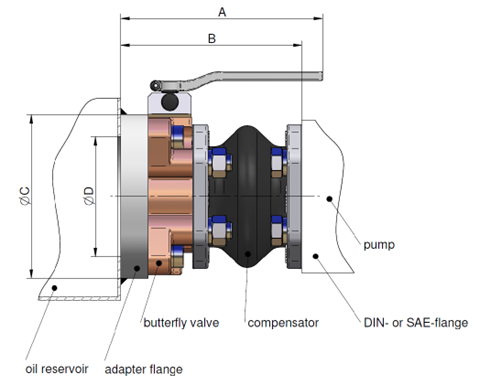
Our butterfly flange with SAE and DIN connections allows for integration with elastic elements (rubber compensators), creating a short, cost-effective connection to the pump port.
Adjustable Mechanism: The lever position and handle direction (clockwise or counter-clockwise) can be easily modified by adjusting the switch bracket.
Maintenance Note: Butterfly flanges should only be operated when fully mounted and with lubricated seals. Compared to traditional Wafer-type valves, our SAE series requires significantly less installation space.
Fig 3. Technical assembly diagram illustrating the SAE butterfly valve and expansion joint dimensions.
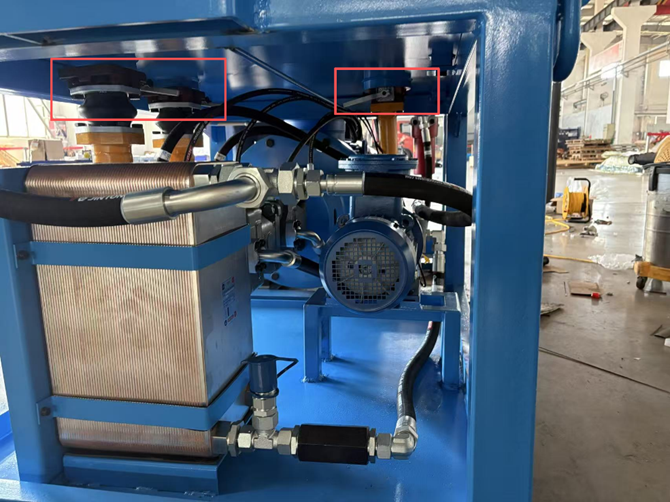
Fig 4. Field installation: SAE butterfly valve paired with a rubber compensator on a TBM hydraulic unit.
Fig 5. Practical application of a standard wafer butterfly valve in a large-scale industrial HPU suction line.
II. Reliable Sealing & Advanced Corrosion Protection
Long Service Life: Optimized eccentric designs minimize wear on the seal face.
Anti-Corrosion Options: Available with electrophoresis or electroplating coatings, ideal for harsh environments such as offshore wind power.
Operational Safety: Equipped with locking devices to prevent accidental operation and built-in brackets for seamless inductive switch installation.
Appendix: Classification of Butterfly Valves by Eccentricity
Type
Structural Features
Characteristics
Ideal Applications
Concentric
Stem, disc, and body centers are aligned.
Simple structure, cost-effective, easy to manufacture.
Low-pressure systems (water/HVAC). Not for high-temp/high-pressure due to seal wear.
Single-Offset
Stem is offset from the disc center.
Reduces seat compression but maintains friction during travel.
Moderate pressure/temperature where absolute sealing is less critical.
Double-Offset
Stem is offset from both the disc and body centers.
Disc “lifts” off the seat immediately upon opening. Reduces wear and allows for Metal-to-Metal seals.
Oil & Gas, Chemical, Power Generation. Handles mid-to-high pressures.
Triple-Offset
Adds an angular offset (conical seal face) to the double-offset design.
Changes from “Position Sealing” to Torque Sealing. Zero-leakage with metal seats. Pressure-assisted sealing.